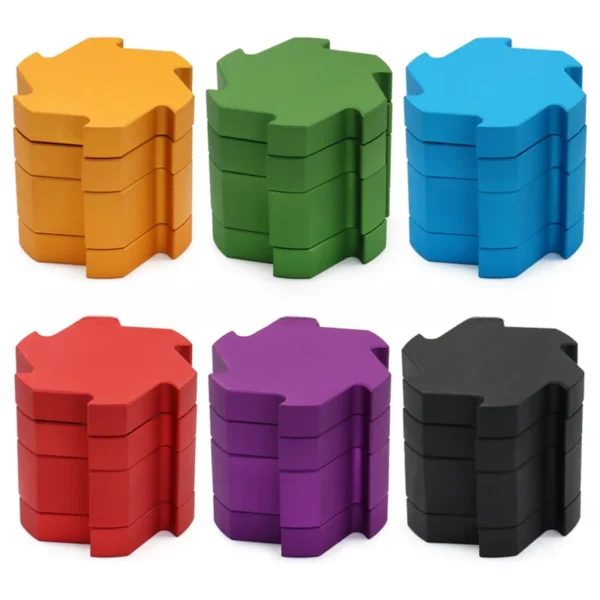
Two grinders can have the same outside diameter and still offer very different products to your customers. One may have a shallow grinding chamber; another may devote more of its height to storage. A photograph of the closed lid will not reveal that difference.
To choose a wholesale herb grinder, work from the intended assortment to the sample specification: size, grinding geometry, chamber layout, material, finish and packaging. Decide what job each model has in the range before adding colors. That makes the buying decision easier to explain and the next reorder easier to repeat.
Begin with a small, purposeful assortment
A distributor might need a compact model for limited display space and a larger model with additional collection chambers. A private-label brand might instead prefer one consistent body shape in a few finishes. Those are different briefs. Ordering every available combination can split the budget across too many stock-keeping units before demand has been established.
Write a one-sentence role for each proposed model. For example: “a compact threaded model for our entry range” or “a larger magnetic model for a coordinated tray set.” These are hypothetical assortment choices, not sales forecasts. Ask whether the packaging, spare components and reorder availability fit that role.
Diameter is only the first measurement
Request outside diameter, overall height and useful chamber dimensions. The grip profile and wall thickness take up part of the outside measurement, so equal diameters do not guarantee equal capacity. A taller unit is not necessarily a larger grinding chamber either.
MyPakg’s four-layer zinc alloy grinder lists diameter options from 40 to 75 mm. That is a product-specific range, not an industry sizing rule. The threadless aluminum model lists 63 × 57 mm. Use these as concrete candidates for a sample comparison rather than assuming the larger number is the better choice.
| Measurement or feature | What to record | Why it affects buying |
|---|---|---|
| Outside diameter and height | Finished sample dimensions | Display fit, grip and retail packaging |
| Grinding chamber | Usable depth and internal layout | Working space cannot be inferred from the closed body |
| Grip | Knurling, ribs or shaped edges | Handling differs even at the same diameter |
| Collection sections | Number, accessibility and screen arrangement | More parts introduce more areas to inspect and clean |
| Packed unit | Box size and actual packed weight | Freight and shelf planning require the complete unit |
Inspect teeth and clearance together
Tooth shape is visible in a catalogue; consistent assembly is harder to judge. Ask for photographs of both working halves and a physical sample of the exact model. Examine alignment, spacing, clearance, burrs and any visible contact marks. A sharp-looking tooth profile does not prove the mechanism turns smoothly or produces a consistent result.
If you compare working samples, use an agreed, lawful representative material and a repeatable procedure suitable for the product. Record the material condition and amount rather than changing them between models. This is a buyer comparison, not a claim that MyPakg has performed a particular test. Do not publish performance promises from a brief demonstration.
Check the path from the working chamber into the collection area, where present. Hole size and layout should be considered with the teeth and the intended material. Avoid choosing only by tooth count: that number leaves out spacing, chamber size and geometry.
Choose the chamber and opening arrangement
A simple two-piece design gives access to the grinding space when opened. Multi-part models add collection or storage sections, sometimes with a screen. Ask for an exploded view so the supplier’s “layer” description is clear. Count functional sections, and confirm which parts detach.
Threaded models should start and close consistently without forcing. Magnetic or threadless assemblies need their own fit checks; a magnetic connection is not a promise of child resistance or a secure transport lock. Hand-crank designs introduce a handle and additional moving parts to inspect. The aluminum hand-crank grinder is an example to compare if that operation suits your range.
Also consider cleaning access. Can the sections be separated as intended? Is a screen removable or fixed? Ask for model-specific care instructions and restrictions. Do not assume a cleaning solvent suitable for one metal body is suitable for its coating, seals or other components.
Separate the metal specification from the surface finish
“Metal” is too broad for a purchase order. Request the stated body material and the process used for the finish. Aluminum, zinc alloy and plastic models should not be compared as if their names alone predict service life or perceived quality.
Anodizing is a conversion of the aluminum surface, whereas paint and plating are different finishing routes. The Aluminum Anodizers Council explains the process. A catalogue color does not tell you which process was used. For the material decision, read our aluminum versus zinc alloy comparison.
For a branded order, ask where the logo can be placed and how it will be applied on that finish. Approve the logo on the actual substrate and color. A flat digital proof is useful for placement, but it cannot show the final contrast, texture or edge quality.
Use a sample acceptance sheet
- Record the model, dimensions, finish and packaging revision.
- Photograph the closed unit and all intended removable sections.
- Check edges, working surfaces, visible debris and finish consistency.
- Check opening, closing, grip and assembly without forcing the parts.
- Confirm logo position, readability and the approved color reference.
- Review cleaning instructions and any loose accessories.
- Keep an approved reference sample for the order and reorder discussion.
Agree with the supplier what will be inspected during production and how deviations will be handled. “Same as sample” is clearer when the sample has an identifier and the acceptance points are written down.
Send a quote request that can be answered
Choose your candidate models from our wholesale herb grinders. Then send the quantity per model and color, logo file, packaging preference, destination and required arrival date. Ask about current MOQ, sampling charges, artwork approval and production scheduling; these details vary by model and order.
If a tray will be included, provide the proposed set layout before approving a retail box. Request a model-specific wholesale quotation with your shortlist and the acceptance points that matter to your customers.