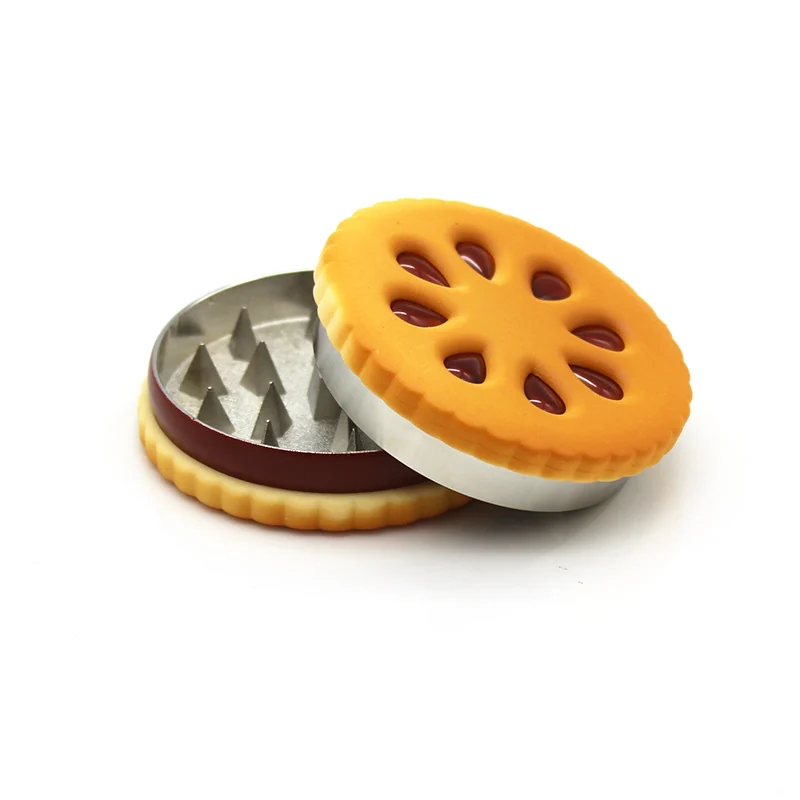
Short answer: inspect a grinder in the same order every time: identity, dimensions, lid movement, teeth clearance, threads or locking system, chamber parts, surface finish and packing. Record the result against the sample code. Ten disciplined minutes reveal more than an hour of comparing catalogue adjectives.
A sample box arrives with six grinders. One feels heavy. One spins smoothly. One has a bright finish. If the buyer simply chooses the favorite, the decision is difficult to explain later—especially when the production shipment feels slightly different. A one-page check turns preference into a usable specification.
Minute 1: identify the exact sample
Photograph the grinder assembled and separated. Record the supplier model, diameter, height, layer count, color and any packaging code. Do not rely on a chat image or a handwritten sticker that can be separated from the sample.
Minutes 2–3: measure and weigh the finished unit
Measure the actual product, not only the listing. Record overall diameter and height and, if important, usable chamber dimensions. Weigh the complete unit and note whether accessories or packaging are included. Weight can help monitor consistency, but it does not prove material grade.
Minutes 4–5: operate the lid and grinding section
- Rotate through several full cycles without contents.
- Feel for scraping, tight spots and sudden looseness.
- Check whether teeth appear to contact each other or the wall.
- Observe vertical and side-to-side lid movement.
- Check that the magnet or locking feature seats consistently.
Do not chase “the longest spin.” Smooth operation and controlled clearance matter more than a showroom trick.
Minutes 6–7: inspect threads, chambers and removable parts
Start every threaded joint gently. A thread that needs force may be crossed, contaminated or poorly aligned. Check for sharp burrs, visible chips and residue. If a screen, scraper or insert is included, confirm its fit and how it is packed.
For a threadless model, inspect the locating and locking features instead. The absence of a screw thread does not remove the need for repeatable alignment.
Minute 8: inspect the finish under angled light
Turn the sample slowly under a bright, neutral light. Look for:
- uneven color or gloss;
- thin coverage at edges;
- dust, fibers or embedded marks;
- chips near mating surfaces;
- unwanted coating inside contact or threaded areas;
- logos that are off-center or unclear.
Use photographs from the same angle and lighting for different samples. This makes comparison much easier than six unrelated phone pictures.
Minute 9: check edges and cleanliness
Run a cloth—not a bare finger—around accessible edges to detect snagging. Inspect cavities for loose particles. Agree on cleaning and packaging expectations before production; do not assume every dark speck is harmless or every polished surface will arrive fingerprint-free.
Minute 10: inspect the retail and transport packing
Place the grinder back into its intended pack. Does it move and rub? Are separate layers protected from each other? Can the carton survive ordinary stacking without transferring pressure directly to the lid? A good product can still arrive damaged in weak packing.
| Result | Record |
|---|---|
| Pass | Meets the agreed measurable and visual criteria |
| Conditional | Acceptable only after a defined correction and new evidence |
| Fail | Do not approve this sample as the production reference |
Turn the selected sample into a specification
Write down the accepted dimensions, weight tolerance agreed with the supplier, layer arrangement, color reference, logo position, finish, included parts and packing. Require notice before material, tooling, finish or component substitutions. Keep the signed or photographed reference sample.
Compare the questions in our wholesale grinder selection guide and the aluminum versus zinc alloy comparison. Those guides create the shortlist; this inspection decides whether the physical sample earns approval.
Questions buyers often ask
Can I identify aluminum or zinc alloy from weight?
No. Finished weight is influenced by dimensions, wall thickness and construction. Use supplier documentation or suitable material verification when material identity matters.
Should the lid spin freely?
It should operate consistently for the design. Excessive looseness, scraping or tooth contact deserves investigation; there is no single spin-time rule for every grinder.
How many samples should be checked?
One sample can support design selection, but it cannot describe production variation. Agree on pre-production and incoming inspection quantities appropriate to the order.
Browse wholesale herb grinders or ask MyPakg for a model-specific sample and packing brief.
For a model-specific sample comparison, review the threadless magnetic grinder.