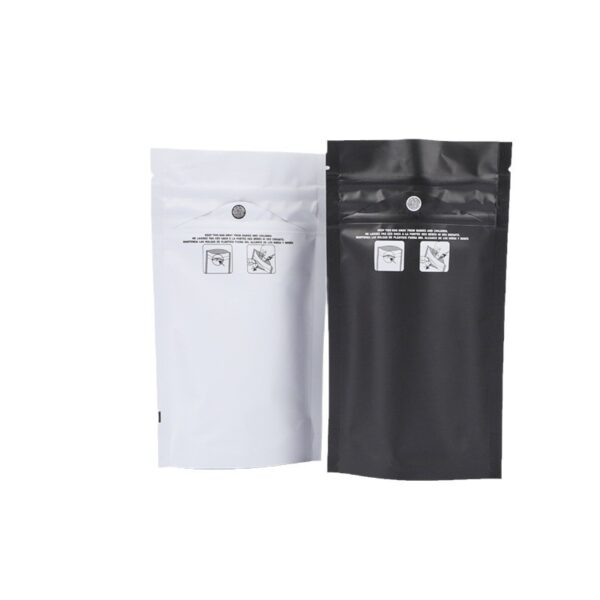
A closure that feels difficult to open is not enough to establish child resistance. For wholesale buyers, the useful question is whether the finished package, its opening instructions and its supporting evidence match the configuration being ordered. That means looking beyond a cap or zipper photograph.
This guide explains how child-resistant packaging works and how to review the evidence behind a supplier’s claim. It is a purchasing checklist, not a substitute for package testing. Requirements depend on the product and destination market; an empty container does not become suitable for every regulated product simply because its listing describes a child-resistant closure.
The mechanism creates a deliberate opening sequence
Many designs require an action that is less obvious than simply pulling a lid or separating two zipper lips. A push-and-turn closure asks the user to apply downward force while rotating. Other designs require squeezing designated areas, aligning parts or gripping specific tabs before pulling. The exact sequence belongs in the instructions for that model.
On a flexible pouch, the film and the closure work together. Grip areas, available space above the zipper and the stiffness of the finished bag can affect how a user holds it. On a rigid jar, the cap must engage the matching container finish. A familiar-looking cap fitted to a different neck is not automatically an equivalent package.
For a concrete starting point, compare the opening instructions and available specifications for our pinch-and-pull stand-up pouch and 4 oz glass jar with push-and-turn lid. These are different formats to investigate, not a claim that either has been approved for your particular application.
Read the performance evidence, not just the certificate heading
The U.S. Consumer Product Safety Commission explains that special packaging must make access difficult for young children while remaining usable by adults. Its guidance points to defined child and adult test procedures, rather than a buyer’s informal opening trial. See the CPSC special-packaging questions and answers.
When requesting documentation, ask for enough identifying information to connect the report to the quotation. A report number without a package description leaves a gap. Keep the report, approved drawing, component specification and quotation together so that your compliance reviewer can check the relationship.
| Report detail | Purchase-order cross-check | Question if it differs |
|---|---|---|
| Package and closure identification | Model, cap or zipper reference and drawing revision | What supports applying this report to the quoted combination? |
| Dimensions and construction | Bag dimensions, rigid container geometry and material specification | Is the proposed size or material within the documented scope? |
| Test method and results | Destination-market requirement selected by your reviewer | Does the report address the required child and adult evaluations? |
| Instructions and sample condition | Printed opening steps and production configuration | Will the supplied package match the tested instructions and condition? |
| Document identity | Report date, issuer, reference and complete pages | Can the issuer clarify an unclear or incomplete statement? |
Do not turn a supplier’s phrase such as “tested closure” into “approved finished package” in your own sales copy. Record exactly what the document covers. If the evidence is incomplete, make resolving it a condition of purchase rather than quietly assuming equivalence.
Child resistance, tamper evidence and barrier performance are separate
A tear-off strip can show that a pouch has been opened. That observation alone does not establish how difficult it is for a child to reach the contents. Likewise, a gasket, foil layer or tight-fitting lid may be relevant to containment, but it does not prove child resistance.
Build separate lines in the specification for opening protection, first-opening evidence and product protection. This prevents a demonstration of one feature from being accepted as evidence for all three. If an outer seal is removed after first use, ask what protects the contents during later use and how the package should be reclosed.
Make the sample review repeatable
Imagine your purchasing team receives two visually identical samples, but one has a slightly different grip tab. If the difference is not recorded, a later shipment can match the photograph while differing from the sample your team approved. A simple sample record is more useful than an email saying “looks good.”
- Identify the sample. Photograph it closed and open. Record the model, revision, dimensions and any component markings.
- Read the instructions first. Check that wording and diagrams describe the actual actions, remain legible at production size and are not covered by a label.
- Review filling and closing. Establish who fills the pack, how the closure is engaged and what the production team checks before dispatch.
- Check the intended contents. Use representative product for fit and compatibility review under an appropriate protocol. Do not assume equal weights occupy equal volumes.
- Document concerns. Record incomplete engagement, confusing instructions, damaged tabs or unexplained variation. Ask for a corrected sample where needed.
These are adult purchasing and quality-control checks. They do not replace formal testing, and children should not be recruited for an informal home or workplace trial. Your qualified testing provider should manage any required assessment under the applicable method.
Control changes after approval
A packaging order can change between sampling and production: a film substitution, a new closure supplier or revised printing may be proposed. Ask the supplier to identify changes before production and obtain written acceptance from the responsible reviewer. CPSC guidance recommends reassessment when relevant materials, manufacturing, contents or package combinations change; see its PPPA FAQ.
A useful purchase condition is to attach the approved specification and require notification of substitutions. Also agree how incoming goods will be identified against that revision. Keep one approved reference sample where practical, together with the artwork and the documents supporting the order.
Questions to settle before requesting a bulk quote
- What product will be packed, and where will it be sold?
- Is the package opened once or repeatedly, and who performs the filling?
- Which exact size, closure and material combination is being quoted?
- Which documentation does your market reviewer require?
- What are the current MOQ, sample options and separate production and shipping estimates?
- How will changes, sample approval and shipment inspection be recorded?
If the format is still undecided, read our comparison of child-resistant bags, jars and tubes. For the broader sourcing sequence, the existing packaging selection guide covers product information and quotation preparation.
Browse wholesale child-resistant packaging, then send MyPakg your format, dimensions, quantity and documentation requirements. Ask for the current MOQ and a model-specific response before treating a catalogue listing as a finalized specification.